
Tuileries Garden
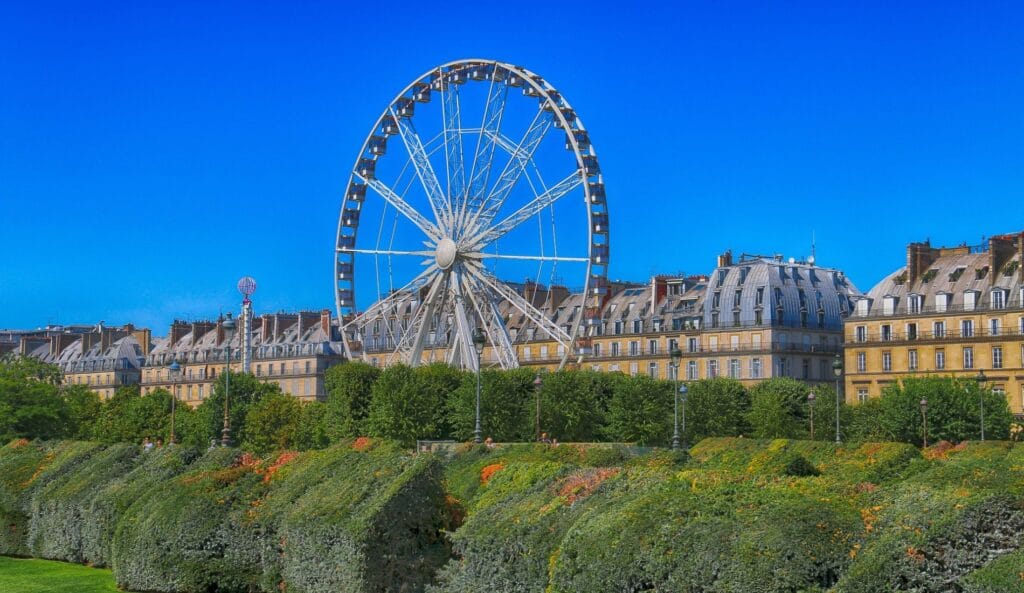
© selenee51 via Pixabay.com
Between the Louvre and Place de la Concorde stretches a green haven that Parisians have strolled through for centuries: the Tuileries Garden. With its straight paths, peaceful ponds, classical statues, and iconic green chairs, it offers much more than a simple natural escape. It is a place of history, art, and leisure, where the past harmoniously dialogues with the present.
The story begins in 1564, when Catherine de’ Medici had the Tuileries Palace built and created an Italian-style garden. But it was in 1664 that the site truly took on its current form: André Le Nôtre, the famous gardener of Louis XIV, imprinted his French style—ordered, symmetrical, and majestic. He transformed this royal garden into a showcase of classical power, with long perspectives, carefully trimmed groves, and a landscape staging worthy of an open-air theater.
Today, the Tuileries Palace has disappeared—destroyed in 1871 during the Commune—but the garden has survived. Even better, it has been transformed into a public space. From the 17th century, Parisians began strolling there. It would become one of the first gardens in the capital to open to the people. A promenade ground under the Ancien Régime, a space for debate during the Revolution, a playground for children, and an open-air art gallery in the 21st century: the Tuileries have never ceased to reinvent themselves.
One of the charms of the place is its ability to combine elegance and simplicity. One can read a book in the shade of a plane tree, sit by a pond to watch the reflections, or simply observe passersby—hurried Parisians, dreamy tourists, children running after a tiny sailing boat. Statues by Maillol, Giacometti, or Rodin watch over these everyday scenes with benevolent stillness.
The garden is also an open-air museum. Along its paths, art appears without barriers. It is not unusual to come across a temporary exhibition, a summer concert, or an unexpected performance. All around, the Louvre, the Orangerie, and the Jeu de Paume remind us that art here is omnipresent, in the stone as much as in the air.
And then there is the light. That particular Parisian light that caresses the foliage, highlights the lines of the hedges, and shimmers on the fountains. At sunset, the garden takes on an almost melancholic atmosphere, as if time were pausing its course, just for a moment.
The Tuileries Garden may be exactly that: a pause within the city, a dialogue between order and freedom, between memory and everyday life. A place to wander slowly, like a book one never truly closes.
