
Place des Vosges
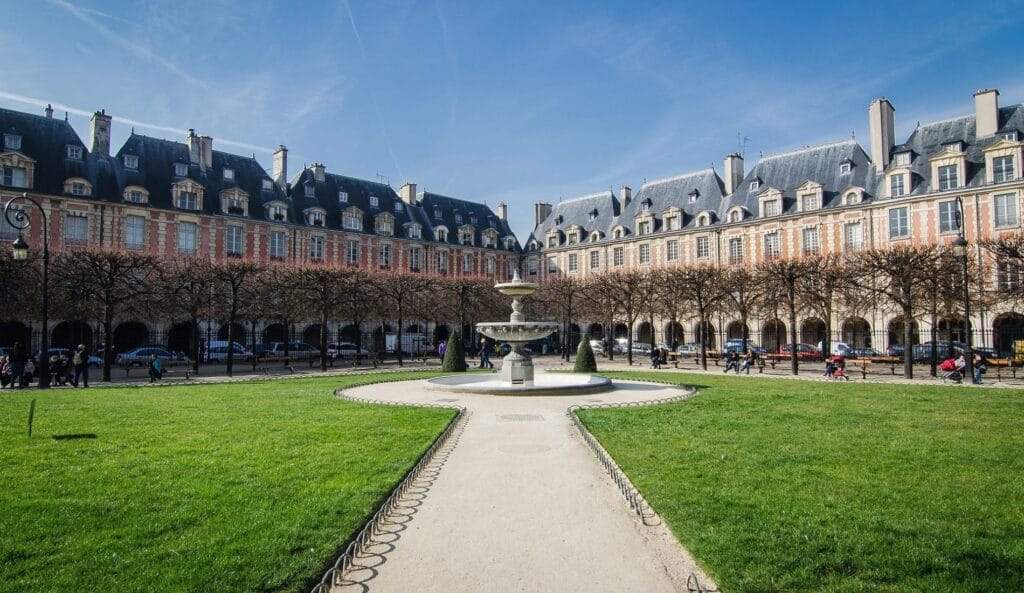
© beanitwoman via Pixabay.com
Just step through one of its arcades to understand why Place des Vosges is one of the most beautiful in Paris. Nestled in the Marais district, it offers a perfect balance of history, architecture, and art of living. Here, everything seems frozen in calm elegance, like a corner of the city preserved from the turmoil of time.
Inaugurated in 1612 on the occasion of the marriage of Louis XIII, the square—then called Place Royale—is the oldest in Paris. It marks a turning point in the city’s urban planning: for the first time, a square was conceived as a coherent architectural ensemble. Each pavilion, whether north or south, has the same height, the same red bricks, the same light stone frames, the same slate roofs. Harmony reigns.
King Henri IV, eager to order and embellish Paris, envisioned this square as a residential setting for the nobility. And the success was immediate. Artists, aristocrats, intellectuals settled there. It quickly became a place of prestige and encounter, the beating heart of a vibrant Marais.
Today, although the nobility has given way to other residents, Place des Vosges has retained all its majesty. At the center, a public garden adorned with perfectly trimmed trees, benches, fountains, and a small playground. It is an island of greenery in the middle of the city, a place where Parisians and visitors come to read, picnic, or simply savor the moment.
The arcades now house art galleries, tea rooms, discreet bookstores, and a few quiet terraces. One strolls slowly, as if moving through a passage out of time. At number 6, the house of Victor Hugo, transformed into a museum, recalls that the writer lived there for more than 15 years. Visitors can discover personal objects, manuscripts, and even his desk facing the window overlooking the square.
Place des Vosges enchants because it does not try to impress. It charms with its measure, its perfect geometry, its changing light throughout the day. In the morning, it is almost silent. At noon, it gently buzzes. By evening, it falls asleep in the warm glow of the street lamps. It embodies a Parisian art of living made of discretion and beauty.
Visiting Place des Vosges also means grasping the soul of the Marais: this blend of heritage, art of living, and culture. It is understanding that in Paris, some places are not only to be seen, but to be inhabited, even just for a moment.
