
Père-Lachaise Cemetery
© Clement Lepetit via Pexels.com
In the east of Paris, within the walls of a wooded enclosure, time seems suspended. Père Lachaise Cemetery is not just a place of rest: it is a city within the city, an inhabited necropolis, a labyrinth of stone and greenery where great historical figures, forgotten anonymous souls, and moved strollers cross paths. Here, death does not rhyme with coldness – it is memory, poetry, presence.
Inaugurated in 1804, the cemetery owes its name to Father François de La Chaise, confessor of Louis XIV, who once lived on a property on these heights. At the time, the idea of burying the dead far from the center of Paris was debated. But the prefect of the time, a certain Napoleon Bonaparte, wanted a monumental place to honor the deceased and to relieve the old cemeteries.
To attract Parisians, a clever decision was made: transfer the remains of famous figures such as Molière, La Fontaine, and later Héloïse and Abélard. Very quickly, Père Lachaise became the most coveted cemetery in the capital. Today, it holds more than 70,000 graves, across 44 hectares of winding paths, hidden stairways, and shaded corners.
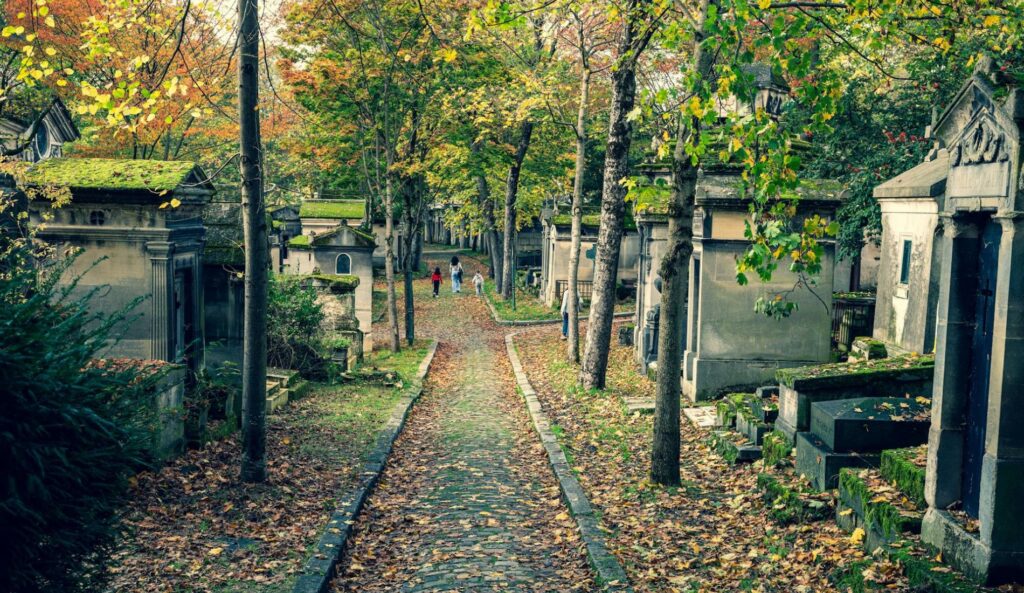
What makes the place unique is its atmosphere. Each grave is different: lavish mausoleums, Gothic chapels, collapsed tombs covered in moss, strange sculptures, inscriptions erased by time. Nature reclaims its rights here with melancholic grace: wild grasses, stray cats, fallen leaves… Père Lachaise lives with the seasons.
Among the most visited graves: Jim Morrison, whose modest stone still attracts rock pilgrims; Oscar Wilde, whose Art Deco tomb was long covered with colorful kisses; Édith Piaf, Jean de La Fontaine, Chopin, Maria Callas, Simone Signoret and Yves Montand, Guillaume Apollinaire… A living map of French and international culture.
But beyond the celebrities, it is the silent stories that move visitors. Family tombs, children, inscriptions erased, traces of faded flowers. Every path seems to carry the memory of entire lives. One does not visit Père Lachaise, one walks through it with respect.
The cemetery is also a place of commitment. The Wall of the Federated recalls the battles of the Paris Commune, and many monuments honor victims of war, deportation, and resistance. The silence here is not empty: it is populated.
Classified as a historic monument, Père Lachaise is also a refuge of biodiversity, with more than 5,000 trees, discreet wildlife, and a soothing atmosphere. It is a space where people come as much to remember as to reflect, dream, or simply walk.
