
Parc de la Villette
© Jean-Marie Hullot via Wikimedia.org
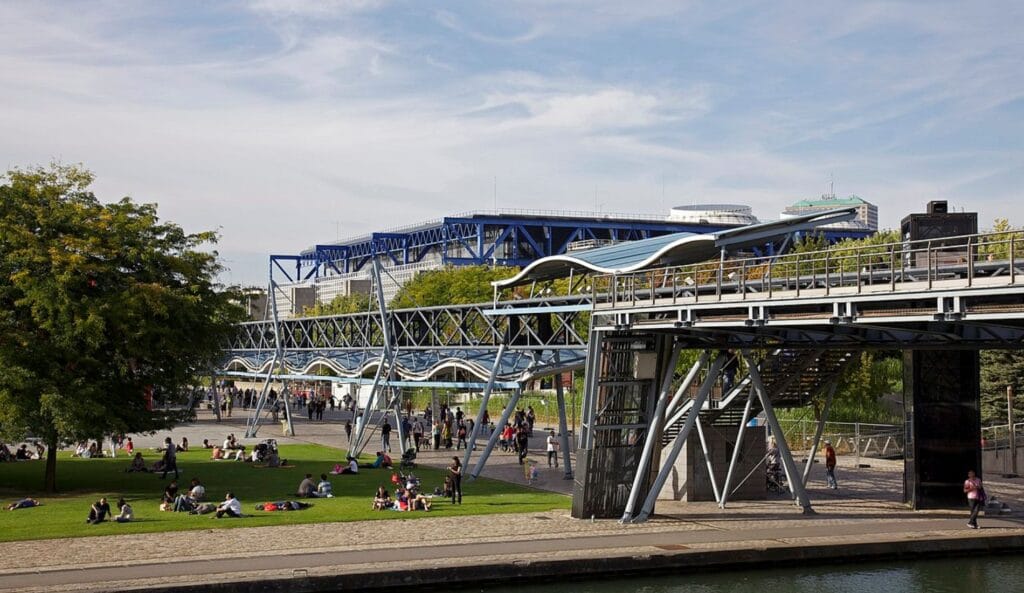
In the northeast of Paris, in the 19th arrondissement, stretches an astonishing space: the Parc de la Villette. Neither quite a park, nor really a museum, nor merely a leisure center, it is a hybrid territory, ever-changing, where culture, science, nature, and architecture meet. Designed as an open-air urban laboratory, it is one of the boldest and most stimulating spaces in the capital.
Created in the 1980s on the site of Paris’s former slaughterhouses, the park is part of a radical rehabilitation project. At the time, the aim was to reinvent the relationship between residents and culture. The architectural competition was won by Bernard Tschumi, who envisioned a deconstructed space, crisscrossed with red lines (the famous folies), where functions, audiences, and disciplines meet freely.
With its 55 hectares, the Parc de la Villette is the largest urban cultural park in Europe. Here, no manicured lawns or central fountains. The space is designed to circulate, explore, and experiment. The red folies — those geometric metal structures spaced every 120 meters — punctuate the landscape like poetic markers. Some house cafés, workshops, or information points. Others serve no purpose at all — and that is what makes them precious.
La Villette is also a major cultural venue. It is home to the Cité des Sciences et de l’Industrie, a true temple of knowledge, with its interactive exhibitions and planetarium. Nearby, the Géode projects IMAX films inside a futuristic sphere, while the Cité de la Musique – Philharmonie de Paris offers concerts, exhibitions, and a fascinating museum dedicated to instruments from around the world.
But the park is not only experienced within its buildings. It also hosts outdoor festivals, concerts, free summer film screenings, sports events, and performances. The large lawns, especially the Prairie du Cercle Sud, become open-air stages. Children delight in the giant playgrounds, strollers wander along the Canal de l’Ourcq, and Parisians come here to run, do yoga, or picnic.
What makes La Villette unique is its freedom of form. It does not impose a route, it suggests detours. It does not categorize, it blends. It is a living, changing place, reflecting the city’s diversity and the richness of its expressions. A 21st-century park, rooted in concrete and thought.
The Parc de la Villette is not a postcard park. It is a park of experience.
