
Palais Garnier
© Pignatta via Pixabay.com
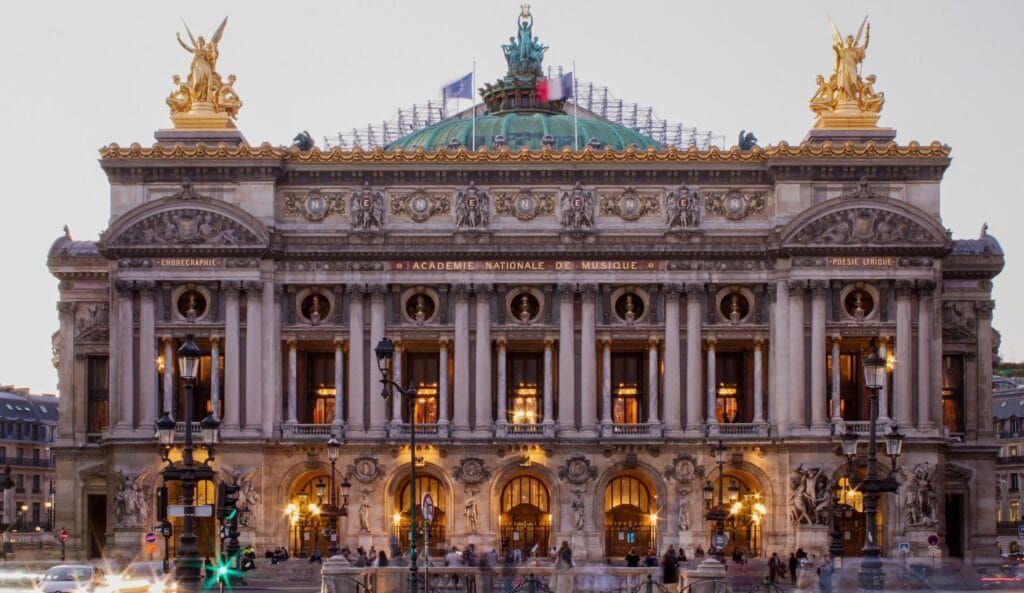
In the heart of the 9th arrondissement, just lift your eyes on Avenue de l’Opéra to be struck by its sumptuous silhouette. The Palais Garnier, an architectural jewel of the 19th century, seems to emerge from a baroque dream. It is much more than an opera house: it is a declaration of love to art, music, and Parisian elegance.
Commissioned by Napoleon III as part of the Haussmannian renovations, the building was designed by a young 35-year-old architect, Charles Garnier, whose name would forever be linked to this lyrical temple. Inaugurated in 1875, the edifice brilliantly blends Neo-Baroque, Classical, and Second Empire styles in an explosion of marble, gilding, and sculptures.
From the forecourt, the façade impresses: Corinthian columns, allegorical statues, a green dome topped by Apollo brandishing his lyre… The Palais asserts its magnificence without asking permission. But it is inside that the experience becomes truly magical.
Past the famous Grand Staircase—immense, theatrical, perfect for seeing and being seen—the visitor enters a lavish universe. The Grand Foyer, with its mirrors, gilding, and painted ceilings, directly recalls the Hall of Mirrors at Versailles. Every detail is designed to dazzle. Here, the opera was as much a stage spectacle as a social one in the hall.
The auditorium itself is a masterpiece. Horseshoe-shaped, it welcomes nearly 2,000 spectators beneath a monumental chandelier weighing seven tons. In 1964, Marc Chagall added a modern touch by painting the ceiling, a vibrant, colorful homage to nineteen famous composers. The contrast with the more classical original décor may surprise, but it contributes to the uniqueness of the place.
But the Palais Garnier is also a world of mysteries. It houses a real underground lake (which inspired Gaston Leroux for The Phantom of the Opera), sumptuous boxes, secret corridors… and a whole artistic life behind the scenes. Even today, operas, ballets, and prestigious events succeed one another here, between tradition and modernity.
Visiting the Palais is to dive into a legendary Paris. One does not feel simply like a spectator, but invited to a continuous celebration of beauty. Even empty of its audience, the place remains inhabited by echoes of lyrical arias, the tiptoes of ballerinas, and invisible applause.
A few steps from the grand boulevards and shopping arcades, the Palais Garnier offers a rare moment of refinement. It is the soul of an eternal Paris, one that shines without ostentation, and that looks at you, always, with a subtle golden wink.
