
Orangerie Museum
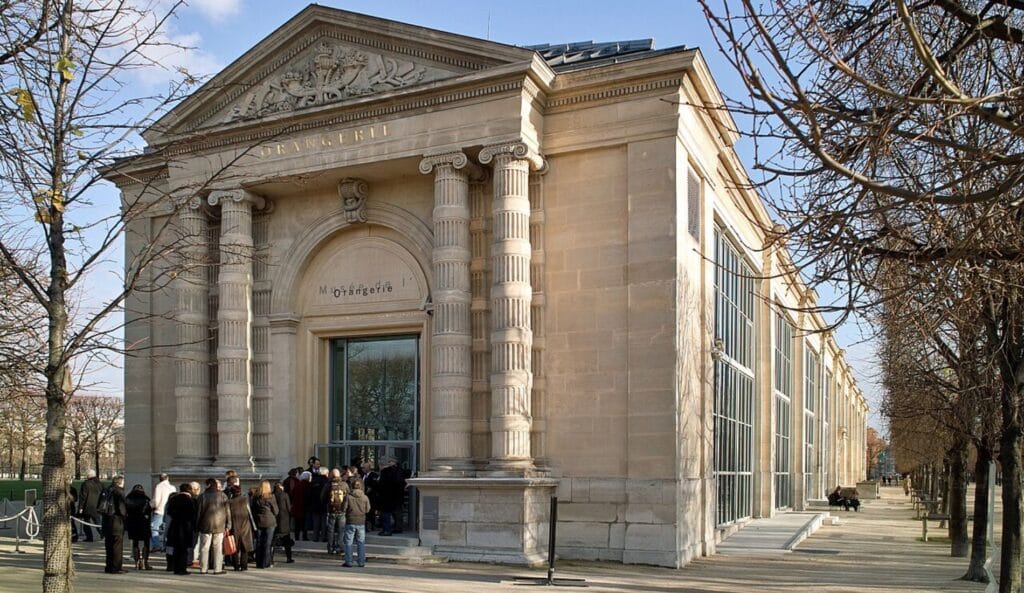
© Traktorminze via Wikimedia.org
At the edge of the Tuileries Garden, in the shade of the trees and the hurried footsteps of the city, lies a treasure often overlooked by hurried visitors: the Musée de l’Orangerie. Behind its discreet façade, however, unfolds an exceptional space, where light, color, and silence compose a breathtaking visual symphony.
The history of the site begins in the mid-19th century. The Orangerie was originally a utilitarian building, built in 1852 to shelter the royal garden’s orange trees during the winter. But its destiny changed after the First World War, when an aging Claude Monet, still driven by a final creative surge, decided to install his masterpiece there: The Water Lilies.
Offered to France as a symbol of peace, these immense canvases are designed to be contemplated in silence. Eight monumental compositions, spread across two oval rooms, bathe in soft natural light, just as Monet intended. One does not enter as in a gallery, but as into a sanctuary. The gaze drifts over the ripples of water, the shifting reflections, the impressionist strokes that verge on abstraction. It is not about seeing, but about feeling.
And yet, the Orangerie is not limited to Monet. The museum also houses a remarkable collection of modern art, notably the Walter-Guillaume collection, assembled in the 1920s. There, one encounters a true concentration of masterpieces: Cézanne, Renoir, Matisse, Modigliani, Picasso, Utrillo, Derain… An intimate stroll through the European avant-garde at the turn of the 20th century.
The rooms, on a human scale, allow for a rare closeness with the works. Time slows here. Each painting becomes a conversation. No bustle, no dense crowds, but a peaceful, almost meditative wandering. The Orangerie stands in contrast to vast labyrinthine museums: here, art breathes — and so do you.
The contrast between the almost cosmic immersion of the Water Lilies and the intensity of Modigliani’s portraits, or the vibrancy of Matisse’s colors, creates a fertile tension. This museum does not need immensity to impress: its strength lies in its coherence, its softness, and its light.
The Musée de l’Orangerie is one of those secret places one loves to recommend as a gift. A place of pure beauty, in the heart of the city yet outside of time. Upon leaving, one has not simply visited a museum: one has traversed an inner landscape.
