
Montmartre
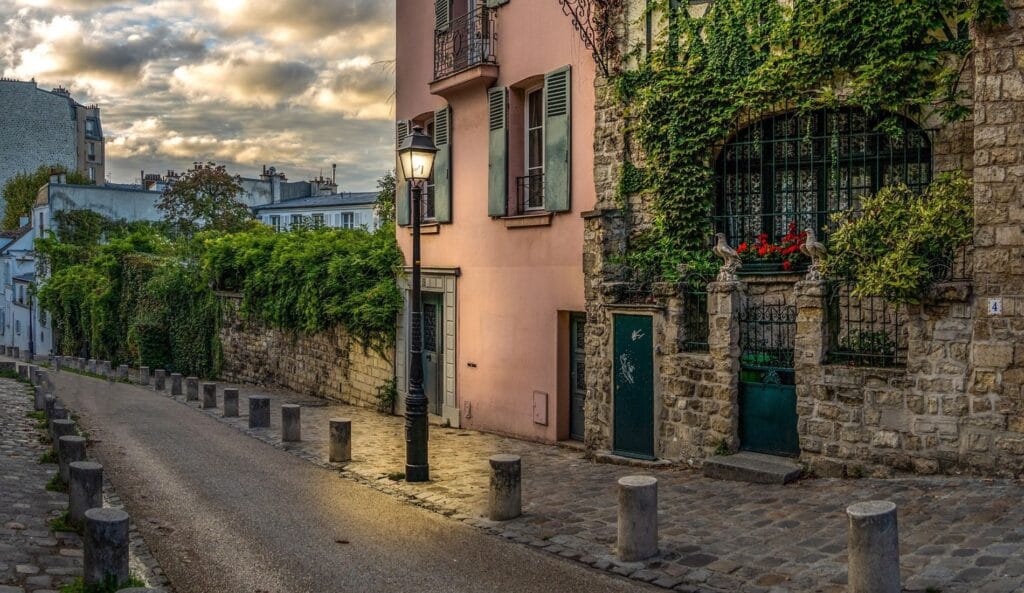
© pierre9x6 via Pixabay.com
Montmartre is not a neighborhood: it is a legend. A village perched on a hill, suspended above the murmur of Paris, where art, festivity, and the popular soul have mingled for centuries in an indefinable charm. As soon as you climb the first steps of the hill, something changes. The air feels lighter, the cobblestones tell stories, and every corner reveals a Paris of another time, intimate, vibrant, wildly alive.
Long on the margins of the capital, Montmartre was a haven for workers, windmills, and vineyards. But at the end of the 19th century, the district attracted a very different population: penniless painters, dreamy poets, and musicians in search of long nights and full glasses. Toulouse-Lautrec sketched the dancers of the Moulin Rouge there, Picasso invented cubism in his Bateau-Lavoir studio, Modigliani loved and drank there, while Renoir, Pissarro, and Utrillo immortalized its streets in light.
Today, Montmartre has changed. Street artists have replaced the great masters, trendy cafés stand alongside tourist galleries, but the spirit of the neighborhood survives, stubborn, elusive. One only has to step off the beaten paths to feel it. Lose yourself in rue de l’Abreuvoir, perhaps one of the most charming streets in Paris, or in the stairways that wind up to the Sacred Heart. Listen to the silence behind the gates of Dalí’s studio. Breathe in the smell of fresh bread near Place du Tertre in the early morning.
The Sacred Heart, indeed, crowns Montmartre like a white stone crown. Its interior, of mystical radiance, contrasts with the effervescence of the esplanade, where musicians and onlookers crowd together to admire one of the most beautiful views of Paris. But the church is recent: it is the surrounding, winding, narrow streets that tell the ancient story, that of the village resisting the Empire, the Commune, fashions, and time.
For lovers of curiosities, Montmartre is full of unusual places: the Museum of Montmartre, hidden in a former artists’ house at the heart of a hanging garden; the vineyards, still cultivated on the hillside, a joyful remnant of its rural past; or the Lapin Agile, a century-old cabaret where the spirit of song still lives in the glow of candlelight.
In Montmartre, one comes seeking more than monuments: an atmosphere, a rhythm, an emotion. There is poetry in the laundry drying at the windows, cinema in every glance exchanged, and always the feeling that behind the painted façade, an artist watches, a memory sleeps, a precious moment awaits us.
