
Jardin du Luxembourg
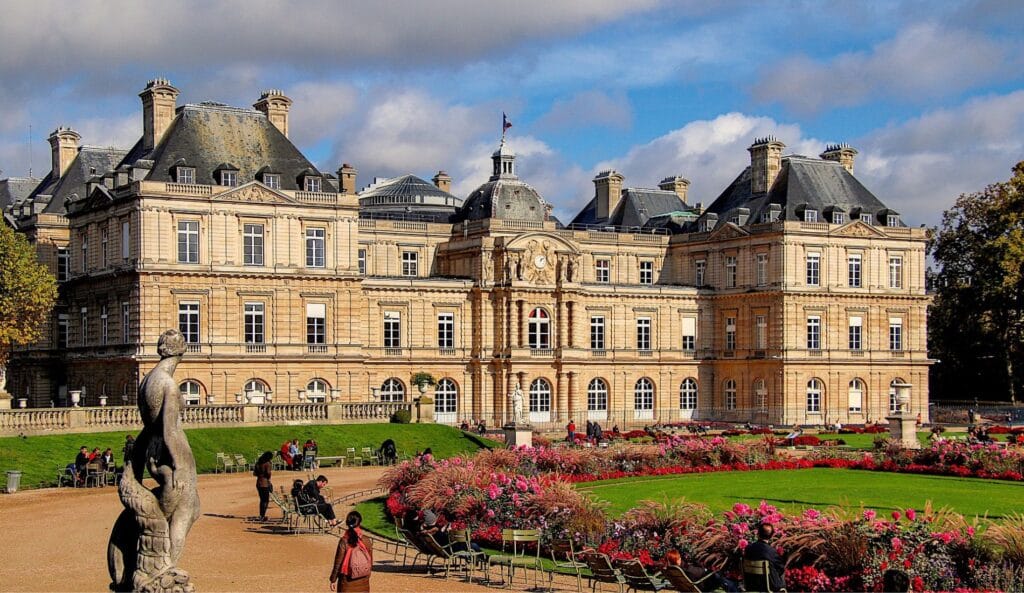
© GAIMARD via Pixabay.com
There are places in Paris that seem made to slow down time. The Luxembourg Garden is one of them. On the border of the Latin Quarter and Saint-Germain-des-Prés, this 25-hectare garden is at once a green lung, an open-air salon, a playground, and a living museum. It is one of the most beloved places by Parisians—and by visitors who know how to lose themselves there.
Its history begins in the early 17th century, when Marie de’ Medici, widow of Henri IV, decided to have an Italian-style palace built for herself, far from the austerity of the Louvre. She called upon Florentine gardeners, who gave the park its Tuscan Renaissance spirit. Later, the garden was redesigned in a French style, then enriched over the centuries to become this hybrid landscape, where symmetry and naturalness coexist in perfect harmony.
The Luxembourg Garden is, above all, an atmosphere. From the entrance, one is struck by a sense of organized calm. The large chestnut-lined avenues, the flowerbeds, the statues that appear around a corner: everything here invites strolling, reading, daydreaming. It is not a spectacular park; it is a familiar park—and that is what makes it charming.
At the center, the octagonal basin stands as an icon. Children launch miniature sailboats there, under the watchful eye of parents and passersby seated on the famous green chairs. All around, Parisians read, students revise, artists sketch the scene in their notebooks. A theater of daily life, peaceful and sincere.
The garden also holds an unsuspected cultural richness. There are more than 100 statues—ranging from Baudelaire to George Sand, and including Bartholdi’s Liberty—as well as the Orangerie, which hosts temporary exhibitions. The Senate, housed in the Luxembourg Palace, oversees the whole, discreet yet present. It is not a royal garden: it is a republican garden.
A little further away, the Medici Fountain offers a romantic setting, with the air of a secret garden. Further on, an orchard, greenhouses, an apiary, a puppet theater, tennis courts, playgrounds… The Luxembourg lives, breathes, and adapts to each generation.
This garden is a condensed piece of Paris: cultivated without being haughty, classical yet alive, orderly without ever being rigid. Whether discovered in spring, in summer, under the autumn leaves, or even covered in frost, it always offers a suspended moment. It is not visited, it is frequented.
