
Louvre Museum
© Leonhard_Niederwimmer via Pixabay.com
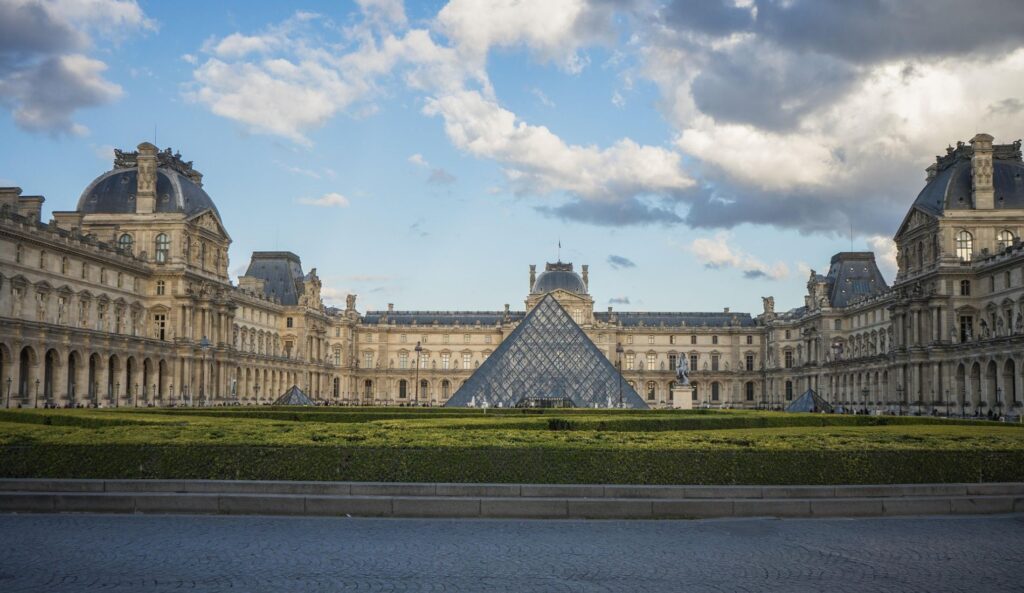
In the heart of Paris, between the tranquil banks of the Seine and the elegance of the Tuileries Garden, stands a monument matching human ambition: the Louvre Museum. Behind its classical façade and its iconic glass pyramid, the world’s largest art museum unfolds its treasures, a living witness of more than 800 years of history.
Before housing the Mona Lisa or the Venus de Milo, the Louvre was a medieval fortress, built by Philippe Auguste to protect Paris from invasions. It later became a royal residence, then a revolutionary museum in 1793, opened to the people in the midst of post-monarchical upheaval. Today, the Louvre is far more than a museum: it is a city within the city, a bridge between civilizations, a labyrinth of wonders.
With its 35,000 works on display (out of a collection of more than 500,000), spread across eight departments, the Louvre is a journey through time. Here, every room is a world: Egyptian sarcophagi, Mesopotamian frescoes, Greek sculptures, Renaissance masterpieces, the grand canvases of Delacroix or Géricault. Far from being a static inventory, the museum offers a sensory and intellectual experience, where one can go from a sphinx to a Raphael in just a few steps.
But what makes the Louvre so unique is that it also tells its own story. In its galleries, one can still feel the presence of kings, revolutionaries, and passionate curators who shaped its collection. You stroll under the painted ceilings of the Galerie d’Apollon, pause before the Code of Hammurabi, then marvel at the modernity of an Etruscan statue. Each work seems to say: “I am the witness of a vanished world, yet still alive.”
And then there is the unmissable: the Glass Pyramid, designed by Chinese-American architect Ieoh Ming Pei. Inaugurated in 1989, it long divided opinion before becoming an emblem. Its blend of past and present perfectly symbolizes the spirit of the Louvre: deep respect for heritage, yet always looking toward the future.
Visiting the Louvre means accepting to get lost. It means giving up on seeing everything in one day in order to better marvel. It also means understanding that art, though ancient, never grows old. It questions us, moves us, and connects us — from century to century, from continent to continent.
