
Louis Vuitton Foundation
© Jo Kassis via Pexels.com
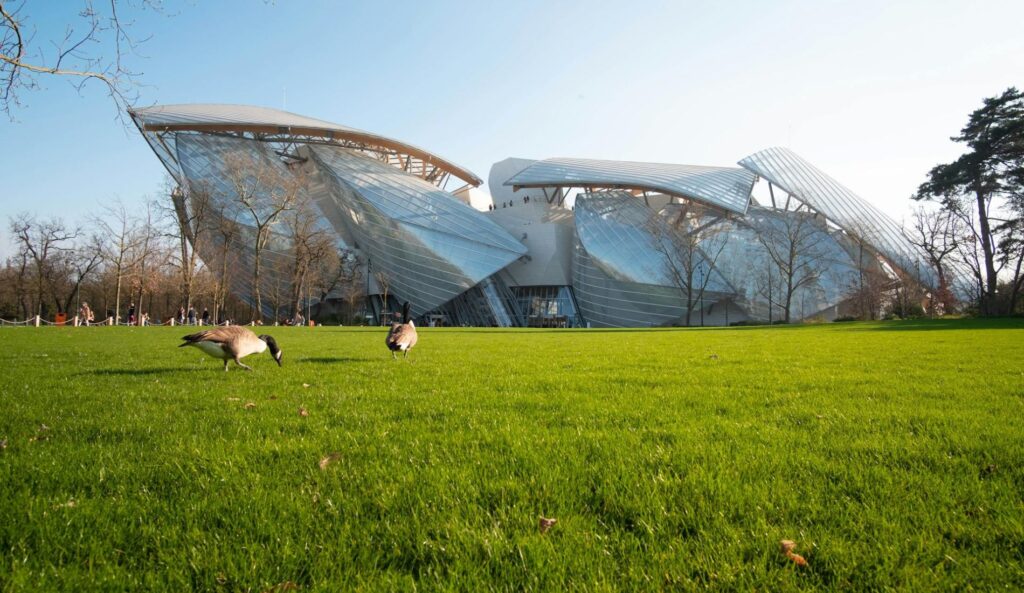
In a green corner of the Bois de Boulogne, where Paris brushes against the limits of its frenzy, rises a building that seems to float. The Fondation Louis Vuitton looks like nothing else: a vessel of glass and steel, with sails stretched by the wind of creation. Imagined by American architect Frank Gehry, it is at once a museum, a work of art, and an architectural manifesto.
Inaugurated in 2014, the Foundation was born from the will of the LVMH group and its chairman Bernard Arnault to give Paris a place dedicated to contemporary art, on par with major international institutions. The result is striking. The architecture, first of all: twelve translucent sails cover a bold structure, full of curves and angles, capturing light, sky, and wind. The building seems to change its face every hour of the day.
But the Foundation is not just an aesthetic gesture. It is a place of exploration. Inside, more than 11,000 m² are dedicated to art, with modular rooms, walkways, and suspended terraces. The space breathes, unfolds, and invites both wandering and contemplation.
The exhibitions are ambitious, always international, often unprecedented. Major retrospectives have been presented – Jean-Michel Basquiat, Cindy Sherman, Mark Rothko – as well as experimental projects combining sound, video, and monumental installations. Contemporary art engages in dialogue with architecture in a subtle and immersive staging.
The permanent collection, which is regularly enriched, highlights artists of the 20th and 21st centuries, from Gerhard Richter to Marina Abramović. The Foundation also supports young creation, with a clear ambition to be a player on the global art scene.
The visit is also sensory. As one climbs through the building, openings offer spectacular views of the Jardin d’Acclimatation, the Bois de Boulogne, or in the distance, the towers of La Défense. The rooftop terrace, in particular, offers one of the finest perspectives of western Paris, framed by glass and sky.
A cultural venue, the Foundation is also a strong urban gesture. It anchors art in nature, connects the center to the periphery, and restores to the Bois de Boulogne a leading cultural role. It attracts a diverse public, mixing art lovers, strollers, tourists, and the curious.
Upon leaving, one keeps in mind the image of a bold Paris, one that is not limited to its classical monuments. The Fondation Louis Vuitton is a promise fulfilled: that art can still surprise, amaze, and move. And that architecture can be an art in itself, when it dares to dream.
