
Le Marais
© David Henry via Pexels.com
There are neighborhoods that encapsulate an entire city on their own. The Marais is one of them. Located on the Right Bank, straddling the 3rd and 4th arrondissements, this district is a condensed version of Paris: medieval and modern, aristocratic and popular, calm and vibrant, intimate and cosmopolitan. The Marais is not frozen in the past—it reinvents it at every street corner.
Its name comes from the marshes that once covered this area. In the Middle Ages, religious orders established convents and gardens there. But it was from the 17th century onward that the neighborhood truly flourished, with the construction of sumptuous private mansions. The Place des Vosges, inaugurated in 1612, is its architectural jewel: a royal square at the heart of a dense urban fabric, symbol of an aristocracy that sought closeness to power and elegance.
Today, these mansions house museums, galleries, schools, or institutions. The Hôtel de Soubise is home to the National Archives; the Hôtel Salé, the Picasso Museum; the Hôtel de Béthune-Sully, the Center for National Monuments. Each courtyard, each gateway, each sculpted transom tells a story—you only need to look up.
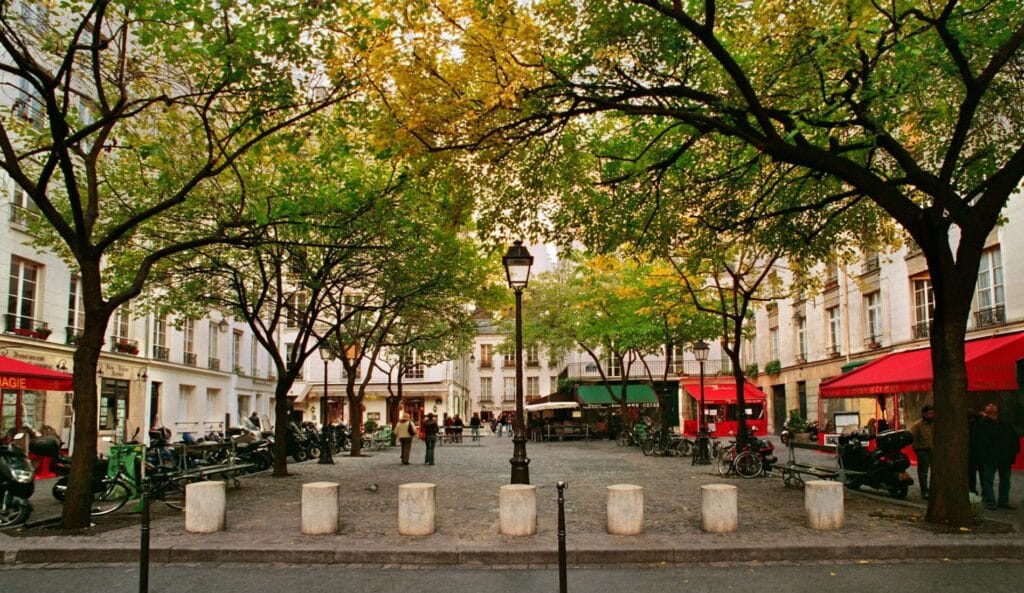
But the Marais is not just an open-air museum. It is also a neighborhood in constant effervescence. Its narrow alleys, lively little squares, bustling cafés, independent bookstores, and designer boutiques make it a profoundly vibrant place. You encounter students, artists, families, tourists, regulars. Here, everyone seems to have a reason to be there.
It is also a major hub of LGBTQ+ culture, with Rue des Archives and its emblematic establishments. The Marais is a space of freedom, tolerance, and celebrated diversity. It always has been, in a way. For it is also the historic heart of Paris’s Jewish community, particularly around Rue des Rosiers. Here you can savor falafels and Ashkenazi pastries, and feel a living memory passed down from generation to generation.
The Marais is a district of art: contemporary galleries, temporary exhibitions, artisans’ workshops… Every step brings a surprise. But it is also a place for wandering: one gladly gets lost here, aimlessly, simply for the joy of discovery. A secret garden, a café tucked behind a courtyard, a shop window full of rare books, a façade draped in wisteria…
What captivates in the Marais is its ability to marry opposites: discreet luxury and bohemian spirit, the sacred and the profane, the past and the present. It is not a postcard-perfect neighborhood. It is a living organism, one you inhabit, traverse, and feel.
