
La Conciergerie
© Pixabay
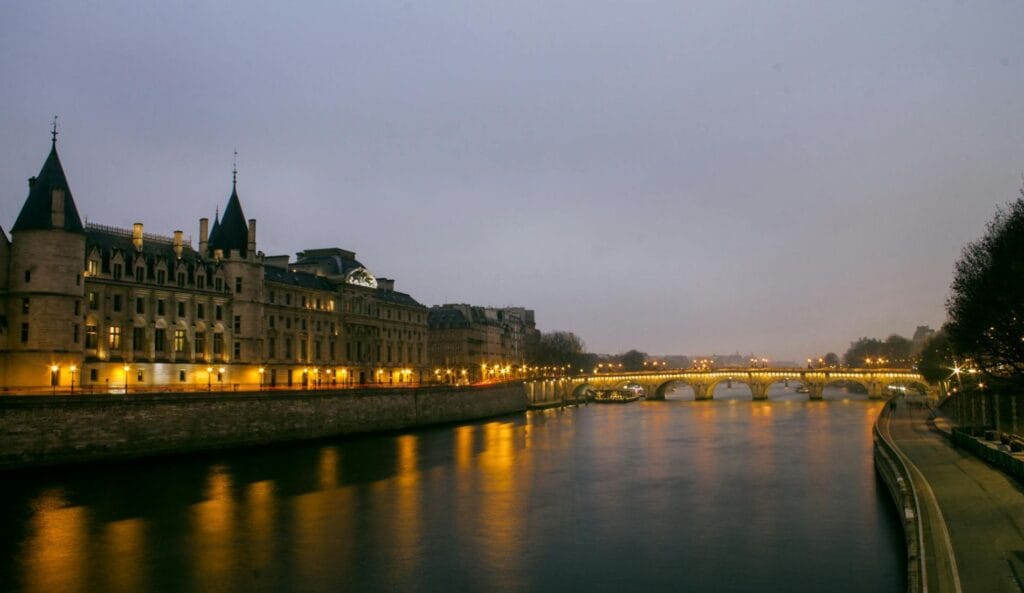
On the banks of the Seine, at the foot of the Pont au Change, the Conciergerie imposes its Gothic silhouette, austere and solemn. With its pointed turrets and thick walls, it looks as though it came straight out of a historical novel. Yet this very real building, nestled on the Île de la Cité, is one of the oldest witnesses of the monarchy and the French Revolution. A place where power, drama, and memory converge.
Before being a prison, the Conciergerie was a palace. In the Middle Ages, it was the center of royal power: the Palais de la Cité. For more than three centuries, the Capetian kings lived and ruled there. Today, only a few impressive remains endure, such as the majestic Hall of the Men-at-Arms – one of the largest Gothic halls in Europe – where the king’s courtiers once feasted.
But it is above all as a prison that the Conciergerie entered legend. From the 14th century, it became a major judicial center, with a court and dungeons. And it was during the Revolution, between 1793 and 1794, that it took on its most famous face: that of the “antechamber of the guillotine.” The dark corridors, the cells, the dungeons – everything here evokes waiting, fear, and the tipping point.
The prison then held hundreds of inmates, among them illustrious figures. The most emblematic: Marie-Antoinette. Imprisoned here before her execution, she spent her final days in a cell now reconstructed. Objects, letters, and panels recount this tragic wait, between solitude and resignation. Danton, Robespierre, Charlotte Corday, and many other revolutionaries also passed through here.
But the Conciergerie is not limited to being a prison of the Terror. The visit immerses the visitor in an experience between reconstructions, historical documents, and digital installations. One discovers the workings of Ancien Régime justice, the conditions of detention, and the architectural transformations of the site.
The contrast is striking between the dark dungeons and the beauty of the monument: Gothic vaults, cold yet noble stone, large medieval fireplaces. This is the paradox of the Conciergerie: a place of suffering within a setting of power.
Today, the Conciergerie is part of the National Monuments circuit. Less well-known than Sainte-Chapelle, its neighbor, it nonetheless deserves full attention. It tells of a Paris that is political, judicial, and human. A Paris of great upheavals, spectacular downfalls, and the darkest pages of History.
Leaving the Conciergerie means coming out a little different. Because here, one measures the weight of time, justice, and memory. And because one still hears, in the thick silence of the stones, the echo of voices long gone.
