
Carnavalet Museum
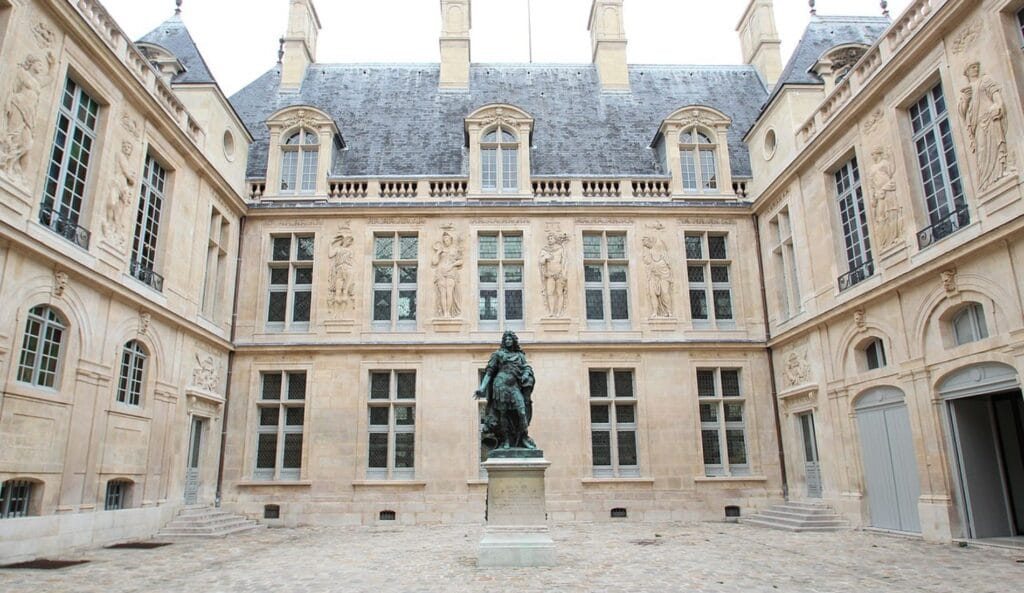
© Lionel Allorge via Wikimedia.org
In the heart of the Marais, behind the gates of an elegant private mansion, lies a unique, intimate, and abundant museum: the Musée Carnavalet. Entirely dedicated to the history of Paris, it is both its memory and its mirror. Here, no masterpieces isolated on white walls, but a total immersion into the centuries, the revolutions, the salons, and the streets of the capital.
Housed in the Hôtel Carnavalet and the Hôtel Le Peletier de Saint-Fargeau, the museum offers a unique journey through more than 3,000 objects, paintings, models, shop signs, sculptures, furniture, handwritten letters, and photographs. The guiding thread? Paris itself, from prehistory to the present day, passing through all its great upheavals.
From the very entrance, the charm works its magic. The buildings, superbly restored, retain the soul of the Renaissance and the Grand Siècle. The museum, reopened in 2021 after an extensive renovation, has managed to modernize its spaces without betraying their character. Visitors move freely between reconstructions of 18th-century salons, showcases of the French Revolution, memories of the Commune, or posters from the 1960s. Each room is a stage, each object a voice.
Among the most striking pieces: the keys to the Bastille, given to Lafayette, a moving portrait of Madame de Sévigné, the letters of Voltaire, or the reconstruction of Marcel Proust’s study, with his famous bed and cork-lined walls. But Carnavalet doesn’t stop at great names. It also gives space to the anonymous, to everyday objects, to the small stories within the great one.
This museum is a kaleidoscope. You see Paris burn, be reborn, beautify itself, grow indignant, have fun. You follow the construction of Notre-Dame, the Revolution of 1789, the splendor of the Second Empire, the resistance during the Occupation, May ’68… Each era is told with sensitivity and intelligence, without grandiloquence, but with a palpable respect for the city’s complexity.
Carnavalet also charms with its accessible dimension. It is a free museum, designed for wanderers as well as enthusiasts. Children find plenty to dream about, students food for thought, and lovers of Paris, reasons to fall in love all over again.
The inner courtyards and gardens, peaceful and blooming, allow for a pause between two eras. Sometimes you hear the bells of a nearby church, or the hushed conversations of a Marais café. Even outside, Carnavalet continues to tell the story of Paris.
Because in the end, that is the secret of this museum: it doesn’t just show the city’s history. It makes us want to be part of it.
